Power and Progress
It’s common knowledge that computers have significantly increased our productivity, right? There’s no doubt it’s much faster to calculate accounting data in Excel than by hand. Now, with AI agents all around us, our productivity is set to skyrocket, isn’t it?
But does technological progress truly lead to shared prosperity? On the surface, it seems like an easy question, yet unfolding it reveals layers of complexity. Who really benefits—society as a whole or a elites? Does technology always improve productivity? And is its impact on society inevitable, or something we can and should manage?
That’s the question set as the key theme of the book “Power and Progress: Our Thousand-Year Struggle Over Technology and Prosperity” by Daron Acemoglu and Simon Johnson, winners of the 2024 Nobel Prize for Economics. As I’ve been recommending this book for about a past month I thought I would sit and write it down.
For those who read Acemoglus’ previous book “Why Nations Fails” it will be expected to see a fact-reach text that you read with joy, though sometimes, yeah just a little you think - ah, that could be a bit shorter.
The authors go from as far as 9000 BCE through Middle Age war and trade inventions, the story of building Suez and Panama Canals, industrial revolution in England and then on computer technology and AI development. For me the latter was the most thought-provoking part. Robert Solow quote from 1987: “You can see the computer age everywhere but in the productivity statistics.” Acemoglu and Johnson argue that total factor productivity (TFP) growth in the US “since 1980 has been less than 0.7 percent, compared to TFP growth of approximately 2.2 percent between the 1940s and 1970s.”
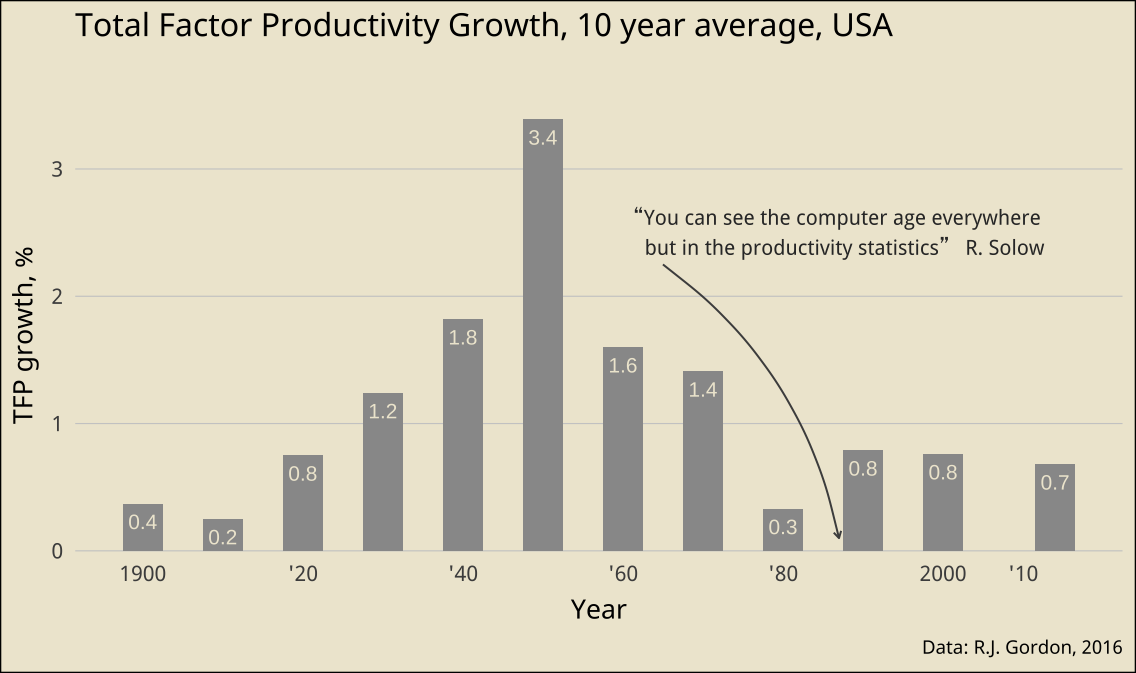
TFP is a residual - part of country’s income that cannot be attributed to labor or capital, so how much more is done with same input. And now coming to AI developments, it stands out that AI mainly progresses to success in sales marketing, which is zero-sum win for society.
Consider this next to a Sam Altmans’ quote: “With these new abilities, we can have shared prosperity to a degree that seems unimaginable today; in the future, everyone’s lives can be better than anyone’s life is now.“ Are we going in the right direction to achieve that? The answer is clear - nope, according to Acemoglu and Johnson.
The book highlights rare moments in history when technology benefited wider society, post WWII time, and more historic events where it primarily served a powerful elite. The story however goes beyond enumeration of facts and significant events from history, though only those on their own are really fascinating!
Even though the majority of the stories that the book covers are not delivering wealth to many but rather to the elites, at the end authors leave the reader with a positive outlook. You can call it ‘techno-optimism’ but in a different way, we still have a choice, they argue. The choice of future path. I guess we’ll know in a decade or two. What do you think?